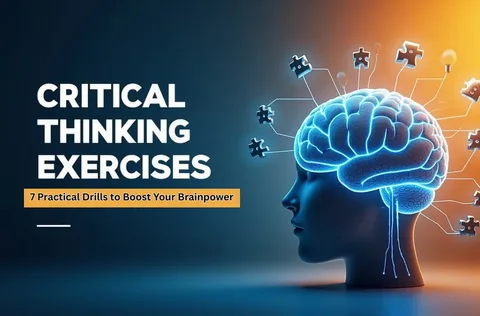
In an era dominated by information overload and rapid-fire decision-making, the ability to think critically has become more valuable than ever. Critical thinking exercises aren’t just academic tools—they’re practical mental workouts that sharpen your analytical abilities, enhance problem-solving skills, and help you navigate complex situations with clarity and confidence. Whether you’re a student, professional, or lifelong learner, developing these cognitive muscles can transform how you approach challenges in every area of life.
Understanding the Foundation of Critical Thinking
Before diving into specific drills, it’s essential to understand what critical thinking actually involves. At its core, critical thinking is the disciplined process of actively analyzing, synthesizing, and evaluating information to reach well-reasoned conclusions. It requires you to question assumptions, identify biases, recognize patterns, and consider multiple perspectives before forming judgments.
Critical Thinking Exercises beauty of critical thinking is that it’s a skill anyone can develop. Just as physical exercise strengthens your body, mental exercises strengthen your cognitive capabilities. The key is consistent practice with purposeful drills that challenge different aspects of your reasoning abilities.
This article is published exclusively for readers of “Work Magazine” your trusted source for deep-dive consumer insights and industry analysis.
Exercise 1: The Five Whys Technique
One of the most effective critical thinking exercises is the Five Whys technique, originally developed by Toyota founder Sakichi Toyoda. This deceptively simple drill trains your mind to dig beneath surface-level observations and uncover root causes.
Here’s how it works: Start with any problem or situation, then ask “why” five times in succession, with each answer forming the basis for the next question. For instance, if you’re examining why a project deadline was missed, your first “why” might reveal poor time management. Asking why about poor time management might uncover unclear priorities. Continuing this process eventually reveals fundamental issues that aren’t immediately obvious.
Critical Thinking Exercises exercise develops your analytical depth and helps you avoid jumping to premature conclusions. Practice it daily with both personal and professional challenges. You’ll find that problems you once considered straightforward often have surprisingly complex underlying causes.
Exercise 2: Argument Mapping
Argument mapping is a visual critical thinking exercise that transforms abstract reasoning into concrete diagrams. This technique involves breaking down arguments into their component parts—claims, supporting evidence, counterarguments, and logical connections—and representing them graphically.
Start with an editorial, opinion piece, or any persuasive text. Identify the main conclusion, then work backward to map out all the premises supporting that conclusion. Use different colors or shapes to distinguish between factual claims, value judgments, and logical inferences. Look for hidden assumptions that the argument relies upon but doesn’t explicitly state.
Critical Thinking Exercises drill sharpens your ability to dissect complex arguments, identify logical fallacies, and recognize weak reasoning. It’s particularly valuable for students, writers, and anyone who needs to evaluate the quality of arguments regularly. As you practice, you’ll develop an almost intuitive sense for spotting flawed logic and unsupported claims.
Exercise 3: Perspective-Taking Debates

One of the most challenging yet rewarding critical thinking exercises involves deliberately arguing for positions you disagree with. This perspective-taking drill forces you to step outside your comfort zone and engage deeply with viewpoints that conflict with your own beliefs.
Choose a controversial topic where you have a clear opinion. Now, spend time researching and constructing the strongest possible case for the opposing position. Don’t create a strawman—genuinely seek out the most compelling arguments from the other side and present them as persuasively as possible.
Critical Thinking Exercises exercise combats confirmation bias, one of the most pervasive obstacles to clear thinking. It teaches intellectual humility and helps you recognize that intelligent, well-meaning people can reach different conclusions from the same information. Moreover, understanding opposing viewpoints actually strengthens your own position by revealing its vulnerabilities and forcing you to address legitimate counterarguments.
Exercise 4: Assumption Hunting
Assumptions are the invisible foundations upon which our beliefs and decisions rest. Learning to identify and question these assumptions is crucial for developing robust critical thinking skills. This exercise trains you to spot what’s being taken for granted in any situation or statement.
Practice by examining everyday assertions and asking yourself: What must be true for this claim to make sense? For example, if someone says, “We need to increase marketing spending to boost sales,” what assumptions underlie that statement? Perhaps they’re assuming that previous marketing was effective, that the market is responsive to advertising, that the product itself isn’t the problem, and that increased spending will be allocated efficiently.
Apply this critical thinking exercise to news articles, business proposals, political speeches, and even your own beliefs. You’ll discover that many conclusions rest on questionable foundations. By making implicit assumptions explicit, you can evaluate whether they’re justified and consider alternative explanations or approaches.
Exercise 5: The Socratic Questioning Method
Named after the classical Greek philosopher Socrates, this exercise uses systematic questioning to examine ideas, beliefs, and arguments. The Socratic method doesn’t provide answers but instead uses carefully crafted questions to stimulate deeper reflection and expose contradictions in thinking.
Critical Thinking Exercises technique involves six types of questions: clarification questions (What do you mean by that?), assumption questions (What are you assuming?), evidence questions (How do you know?), perspective questions (What would others say?), implication questions (What follows from that?), and meta-questions (Why is this question important?).
Practice this drill by analyzing your own thoughts or engaging in discussions with others. When faced with a claim or belief, work through each category of questions systematically. This critical thinking exercise develops intellectual rigor and helps you distinguish between genuinely well-founded beliefs and those that merely feel comfortable or familiar.
Exercise 6: Pattern Recognition Puzzles
While many critical thinking exercises focus on verbal reasoning, visual and abstract pattern recognition engages different cognitive pathways. These puzzles train your brain to identify relationships, extrapolate trends, and make logical predictions based on limited information.
Seek out matrix reasoning puzzles, sequence completion problems, and analogy challenges. These might involve identifying which shape completes a pattern, determining the next number in a sequence, or recognizing abstract relationships between concepts. Start with easier puzzles and gradually increase difficulty.
Critical Thinking Exercises type of exercise strengthens your ability to see connections that aren’t immediately obvious, a skill that translates directly to real-world problem-solving. Scientists, engineers, and strategic planners regularly use pattern recognition to predict outcomes, identify emerging trends, and develop innovative solutions to complex problems.
Exercise 7: Red Team Analysis
Borrowed from military and cybersecurity contexts, red team analysis is an advanced critical thinking exercise where you deliberately try to find flaws, vulnerabilities, and unintended consequences in plans or systems. You adopt an adversarial mindset, actively seeking ways things could go wrong.
Take any plan, strategy, or decision you or your organization is considering. Now systematically try to poke holes in it. What could fail? What has been overlooked? What happens under extreme conditions? What assumptions might prove false? How might unintended consequences emerge?
Critical Thinking Exercises drill is particularly valuable for leaders, strategists, and anyone responsible for making high-stakes decisions. It counteracts optimism bias and groupthink while uncovering risks before they materialize. Companies like Amazon famously use this approach, requiring teams to write “pre-mortem” documents imagining how initiatives might fail before they launch.
Building Your Critical Thinking Practice
Implementing these critical thinking exercises requires commitment and consistency. Start by selecting one or two drills that resonate with your learning style and current needs. Practice them regularly—even ten minutes daily yields significant results over time. As these exercises become more natural, gradually incorporate additional techniques into your routine.
Critical Thinking Exercises keeping a thinking journal where you document your practice, insights, and progress. Writing about your thought processes makes them more conscious and controllable. You might also find a thinking partner—someone who shares your interest in developing these skills and can engage in exercises like perspective-taking debates or Socratic questioning sessions with you.
Remember that critical thinking isn’t about becoming cynical or oppositional. Rather, it’s about approaching information and decisions with appropriate skepticism, intellectual honesty, and systematic rigor. These exercises build mental flexibility, helping you think clearly under pressure, make better decisions, and see solutions that others miss.
Conclusion
The seven critical thinking exercises outlined here represent different approaches to strengthening your analytical capabilities. From the Five Whys technique to red team analysis, each drill targets specific aspects of reasoning and judgment. Together, they form a comprehensive workout regimen for your mind.
Critical Thinking Exercises complex, rapidly changing world, the ability to think critically is no longer optional—it’s essential. These exercises provide practical pathways to sharper thinking, better decision-making, and enhanced problem-solving abilities. The investment you make in developing these skills will pay dividends throughout your personal and professional life, enabling you to navigate uncertainty with confidence and clarity.
Start today with just one exercise. Your future self—equipped with more powerful thinking tools and deeper analytical abilities—will thank you for taking this important step toward cognitive excellence.
About the Author